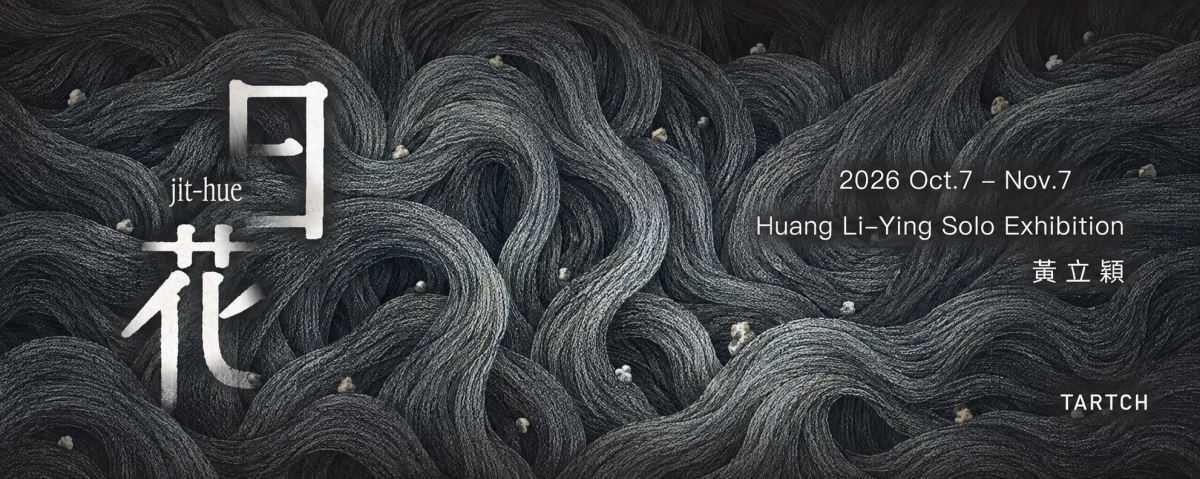
 ji̍t-hue
Some things do not rush to become clear images.
They may appear as a subtle rise on a surface, a darkened plane touched by light, a delicate trace left upon matter—or perhaps as a sensation briefly caught by the body in motion, before it has even been given a name.
Huang Li-Ying’s ji̍t-hue begins with these subtle and uncertain perceptions. Rather than depicting a world already known, the works leave space between the visible and the invisible, allowing perception to unfold slowly through the act of looking.
The “landscapes” presented in this solo exhibition at TARTCH are not direct representations of the natural world. Instead, they emerge as perceptual landscapes shaped through bodily experience.
Forms within the works may at times evoke rocks, clouds, shadows, or fragments, yet they never resolve into specific objects. They arise from the overlapping of memory, light, matter, and perception, hovering between the familiar and the unrecognizable.
Scattered across these surfaces, tiny points of light and traces of gold resist fixed symbolic meanings. They are closer to incidental interventions in everyday life—a passing beam of light, a memory that cannot be fully preserved, or a fleeting moment that leaves behind a trace in time.
Looking, then, is no longer simply an attempt to identify what lies before us. Instead, it asks us to become aware of how we perceive what we see.
Time, Held on the Surface of Graphite
Continuing Huang Li-Ying’s long-standing exploration of graphite, light, and surface, graphite in ji̍t-hue is not merely a medium for drawing. It becomes an interface through which time and bodily action are held.
Through repeated acts of rubbing, layering, and erasure, an initially flat surface gradually develops varying densities and depths. Every mark emerges from a physical gesture, recording an accumulation of time.
Painting, therefore, is not simply the completion of an image, but a process that unfolds slowly.
Time remains on the surface; the body remains within the traces. And light allows these accumulated moments to shift and unfold once again.
The reflective quality of graphite means that the works never possess a single, fixed state of appearance. As the viewer changes distance, angle, and position, details once submerged in darkness may gradually emerge, while marks that appeared clear only moments before may disappear again with the changing light.
The same work can therefore reveal a different presence at every encounter.
Every Movement Becomes a New Way of Seeing
ji̍t-hue is not an exhibition to be taken in at a single glance.
The viewer must move closer, step back, shift position, and allow the body itself to participate in looking before the subtle transformations across the graphite surface can gradually be perceived.
Looking is no longer a matter of standing before a finished work in search of a fixed answer.
The viewer’s movement itself becomes part of the work.
Certain forms emerge into view only to dissolve again; light is caught for a moment, then retreats into darkness as one’s position changes. Between the work, light, space, and the viewer, a relationship takes shape—one that remains continually in flux.
What ji̍t-hue ultimately confronts, then, is not the question of how the world might be depicted, but rather—
how the world reappears through the act of seeing.
Perhaps we do not need to rush to understand everything before us.
Those moments that seem insignificant, or pass before they can even be named, remain genuinely present within our lives: a beam of light, a trace, a memory, a brief moment in which the body encounters the world.
Huang Li-Ying leaves these moments within the depths of graphite—and ultimately returns the act of looking to the viewer.
Some acts of looking are not about finding an answer.
They are about the moment in which we truly begin to perceive.